Piece 01 · 2:32
System On
A voice establishes the conditions for a world that has not yet settled.
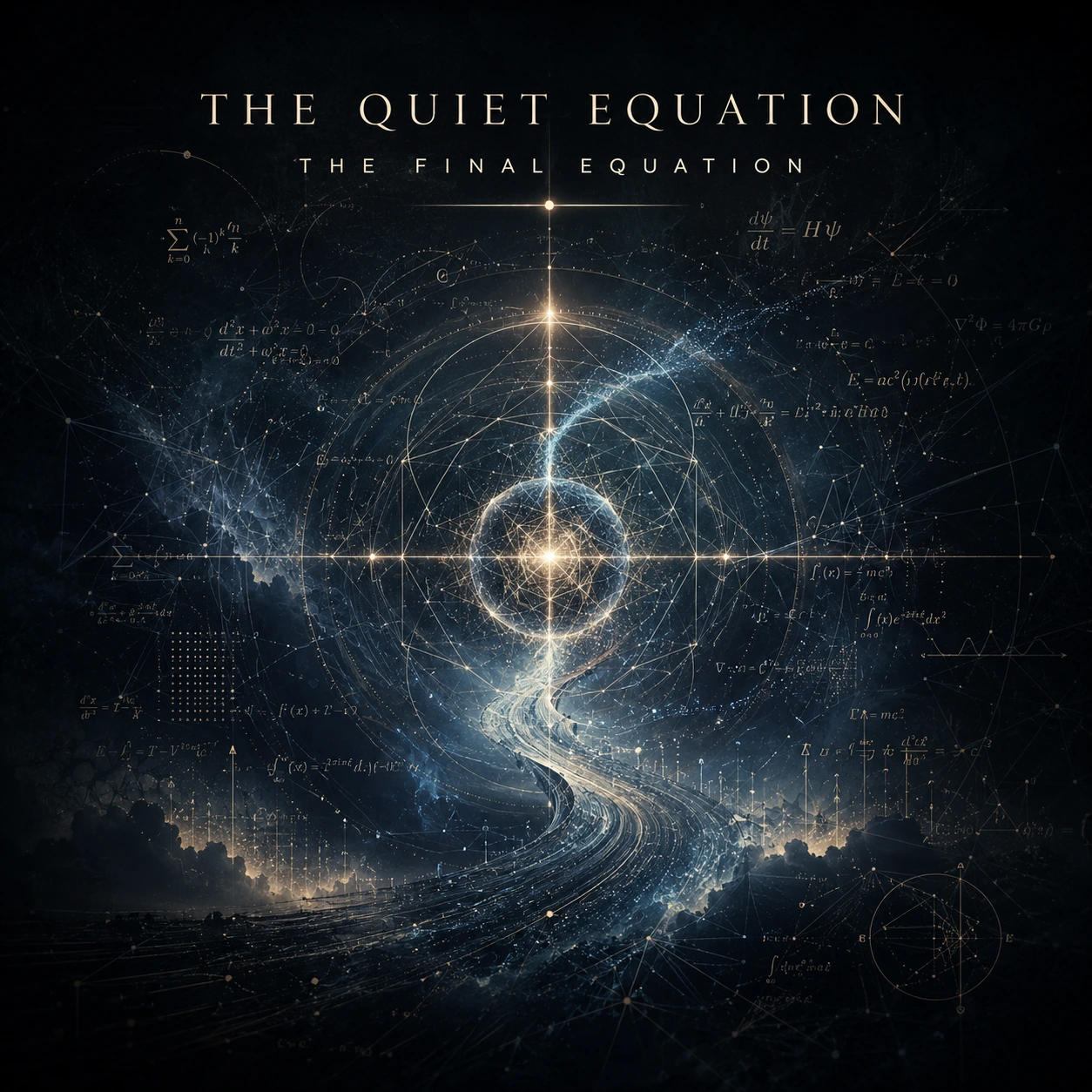
System state: undefined.
“System state: undefined.”
System state: undefined.
The first voice sounds like a machine waiting for its world to be described. In a mathematical model, the state is the collection of quantities needed to specify what is happening now: a pendulum's angle and speed, for example. Undefined is therefore a useful dramatic threshold. The music begins before the model has acquired its coordinates. It also shifts the trilogy's perspective: after looking outward at stars and inward at inheritance, we are about to examine the rules by which a description becomes a sequence of events.
No prior equilibrium. No stable configuration.
Initial conditions set.
“Initial conditions set.”
Initial conditions set.
An initial condition is a starting value, distinct from the rule that changes it. Two pendulums can obey the same equations yet begin at different angles. The announcement is brief, but it establishes a question that will grow across this work: how much of what follows is shaped by where we began? It also echoes the inherited starting points of The Genetic Elegies. We enter a process already carrying circumstances; understanding the rules does not erase the importance of the first moment to which those rules are applied.
Parameters unbounded. Constraints pending.
No guiding structure. No imposed intent.
“No guiding structure.”
No guiding structure. No imposed intent.
These lines separate a system's behaviour from a story about what it is for. A model can describe interaction without assigning a purpose to the result. That is a methodological choice, not a laboratory proof that meaning cannot exist. Here it creates room for an artistic reading in which structure emerges without a narrator arranging every outcome. The impersonal delivery makes the idea feel both unsettling and liberating: the system will not promise us a destination, but it does not require such a promise before anything can happen.
Only variables. Only interaction.
Iteration will begin.
Adjustment follows deviation. Stability follows repetition.
“Adjustment follows deviation.”
Adjustment follows deviation. Stability follows repetition.
The first line introduces correction; the second offers a hope that later pieces will test. Repeating an update can bring a system towards a steady value, but it can also produce cycles or increasingly different states. Try repeatedly halving a number, then repeatedly doubling it: repetition alone tells us very little without the rule. The voice's confidence is therefore dramatically provisional. Convergence will make stability seem attainable; Divergence will reveal why returning to the same procedure is no guarantee of returning to the same outcome.
No outcome specified. No endpoint required.
“No outcome specified.”
No outcome specified. No endpoint required.
A process can be defined by how one state becomes the next without being given a final target. That differs from an optimisation problem, where we deliberately choose something to minimise. The distinction matters because the following work moves between both kinds of language: systems evolving and algorithms searching. These lines hold the larger frame open. The unfinished final phrase, 'Let the…', makes that openness audible on the page as well. The beginning does not complete its own instruction; it leaves the listener to travel through the consequences.
Run sequence initiated.
Let the system resolve.
Let the…